

Skip to project content

JESA 2026 Revamp

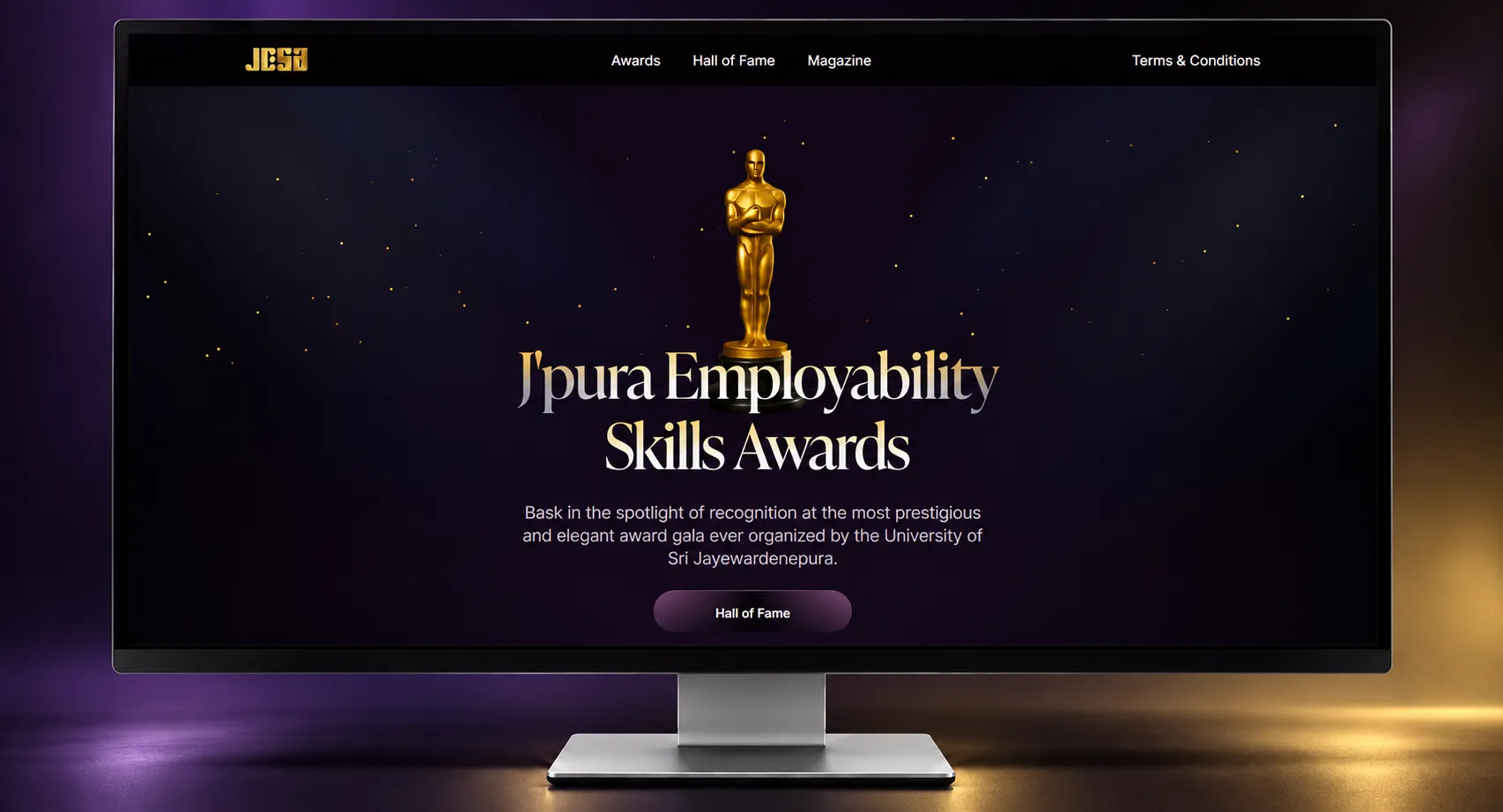
The production-ready 2026 revamp of the J’pura Employability Skills Awards platform for the University of Sri Jayewardenepura, with my contribution focused on quality assurance, content accuracy, and launch readiness.

Role
Quality assurance and content validation
Category
Award platform revamp
Timeline
June 2026 – July 2026
J’pura Employability Skills Awards trophy presentation
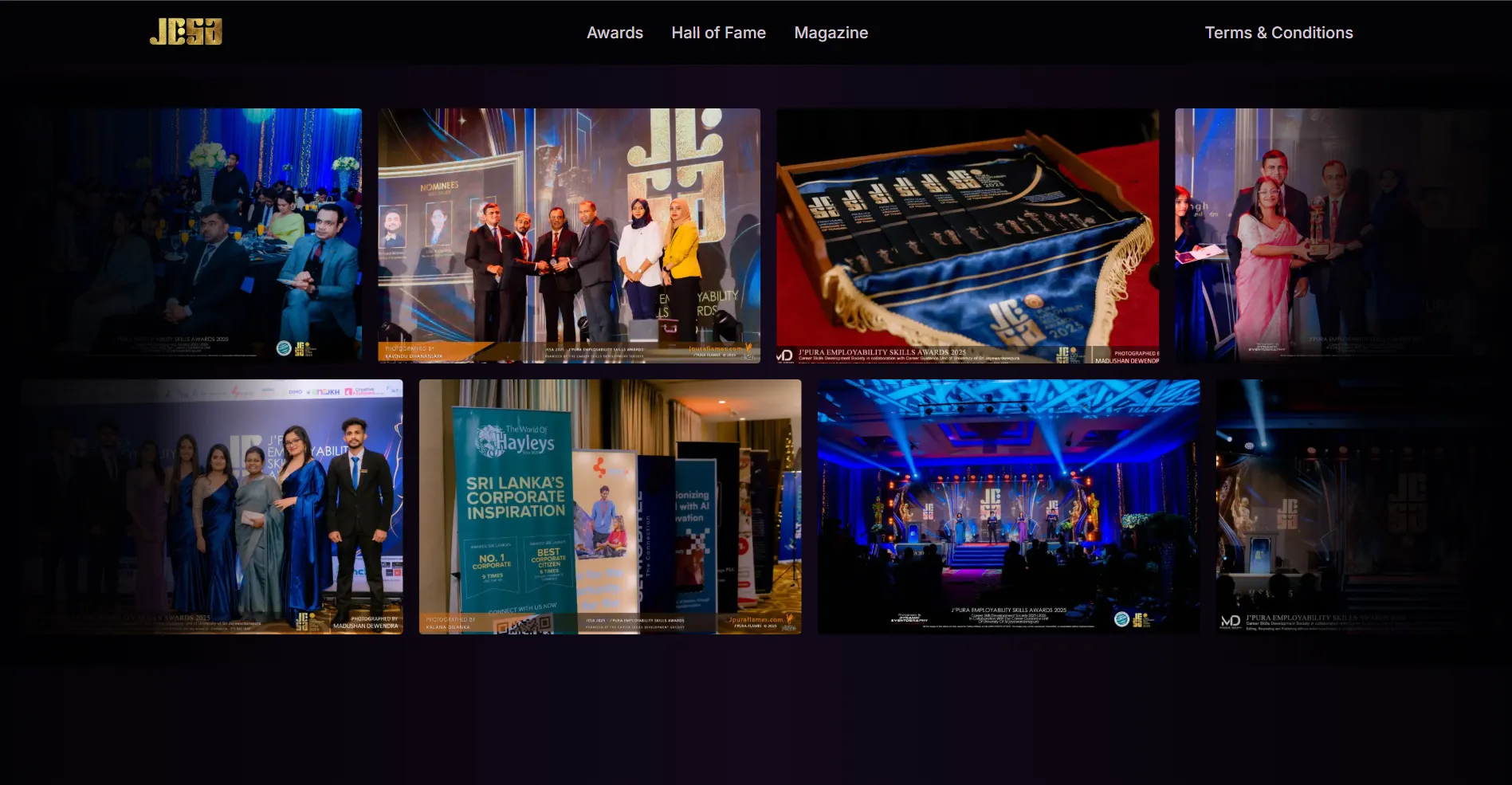
J’pura Employability Skills Awards event gallery
J’pura Employability Skills Awards award categories

Project overview

01

The challenge

The 2025 platform needed to evolve into a stable 2026 production system without carrying forward inaccurate academic content, outdated sponsor information, inconsistent brand assets, or regressions across its dynamic faculty-based application workflows and administrative operations.
02

The outcome

The revamp delivered a more reliable and production-ready JESA platform with verified degree information across more than 12 Management Faculty programmes, corrected event and sponsor content, coordinated brand updates, stronger regression coverage, and stabilized server-side deployment.

Deliverables

  1. 01Faculty-based application workflow validation
  2. 02Management Faculty degree programme audit
  3. 03Event, sponsor, and platform copy corrections
  4. 04Logo replacement and removal coordination
  5. 05Playwright end-to-end regression testing

Project access

Technical details

2026 platform revamp

The 2026 release builds on the previous JESA platform and expands it into a production-ready ecosystem for the University of Sri Jayewardenepura’s annual employability skills awards. The wider platform includes a scalable admin control centre, dynamic application workflows, advanced dashboard operations, and audit logging.

Quality assurance and content accuracy

My contribution centred on quality assurance and launch preparation. I reviewed and updated Management Faculty degree programme listings across more than 12 programmes, corrected event and sponsor-related text, and coordinated required logo replacements and removals before production release.

Workflow validation

Testing covered dynamic faculty-based application journeys and administrative dashboard operations to verify that content, routing, form states, and role-dependent flows behaved consistently throughout the revised platform.

Regression and release confidence

Playwright end-to-end regression coverage was used to exercise critical user journeys and reduce launch risk. Structured QA checks also confirmed that content corrections and visual asset changes remained consistent across public and administrative experiences.

Production stability

At platform level, a critical deployment blocker caused by ESM incompatibility between firebase-admin and jose/jwks-rsa was resolved through a custom JWT verification flow. This stabilized secure server-side operations on the Vercel Node 22 runtime.

Tech stack

  • React
  • TypeScript
  • Tailwind CSS
  • GSAP
  • Firebase
  • Node.js
  • Vercel

Final thoughts

The JESA 2026 revamp reinforced that production readiness depends on more than feature completion. Accurate institutional content, validated application paths, consistent sponsor and brand assets, repeatable regression coverage, and stable deployment behaviour all contribute directly to the credibility of a high-profile university platform.

What I learned

  1. 01

    I strengthened my ability to run structured content audits across interconnected academic and event workflows.

  2. 02

    I gained practical experience validating dynamic faculty-based journeys and administrative operations through repeatable QA scenarios.

  3. 03

    I developed a clearer understanding of how automated regression testing, runtime compatibility, and launch coordination support production reliability.